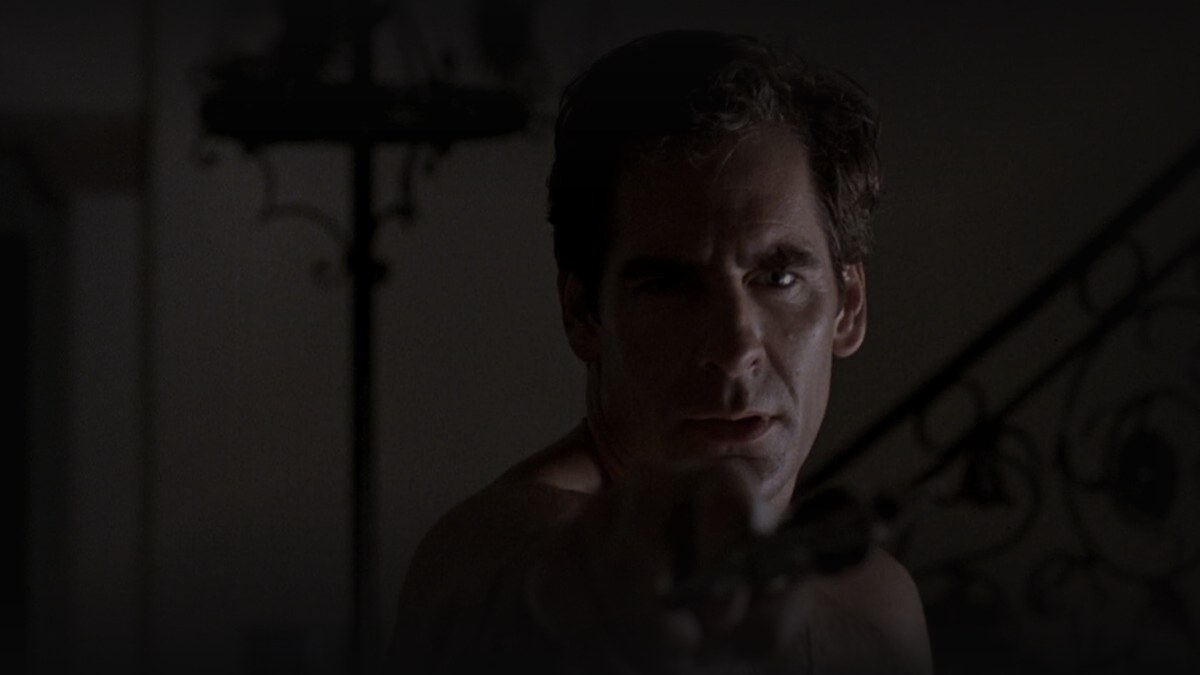
Lord of Illusions (1995)
Barker’s third directorial feature, the underlooked one, sandwiched between Hellraiser (1987) and the long gap before The Midnight Meat Train (2008). Often remembered as the film where he let a hardboiled PI drive the plot, and that friction with his usual horror-puzzle structure is what makes it work. The director found the commercial ceiling of his sensibility and decided to make something personal inside it.
What the film does
Scott Bakula plays Harry D’Amour, a private detective whose last name is the setup and whose job is the thesis: he investigates the supernatural for a living, and his disbelief is the only thing keeping him alive. He takes a case involving a stage magician named Nix who was nearly beaten to death by his own assistant, except Nix’s magic was real, and the beating was meant to finish a deal Nix made decades ago with the Lord of Illusion himself, a demon whose price was Nix’s soul at the peak of his powers.
Famke Janssen plays Swann, Nix’s wife, who is the film’s most complex thing. She is the reason the film isn’t just a detective procedural with magic in it. She’s the one who has to live with what Nix released, and the way she holds that weight changes every scene she’s in. The supporting cast includes Kevin J. O’Connor as a small-time hustler who becomes Nix’s unlikely ally, and Daniel von Bargen as Nix himself, restored from the dead in a way the film handles with more restraint than the trailers suggest.
Why it’s in the canon
Cult classic of 90s occult horror that Barker himself considers his most personal work. The criteria blend is 1+3, I loved it, and I want to remember it. It came out the same year as Se7en and Braveheart and got buried by both, which is part of why it developed the following it has: the people who found it, found it because they were looking.
What stays with me
The private club scene. A tailor shop in New York has a back room where powerful occultists meet, they are not villains, exactly, but they have made compromises to be powerful that the film does not flinch from. It is Barker’s best dialogue because it is drawing-room drama first and horror second: people negotiating power, the demon as a third party in the room, the detective trying to figure out the rules while everyone else already knows them. The scene runs long and earns every minute.
On hand
Yes, DVD + digital. The DVD is the director’s cut (115 min), which is the one to watch. The theatrical cut (98 min) restructures the third act in a way that does not work as well; if you only have access to the shorter version, skip it. The director’s cut adds a Scooter subplot that fixes the pacing and gives the climax a proper setup.
image: still from Lord of Illusions (1995), dir. Clive Barker, via Letterboxd